
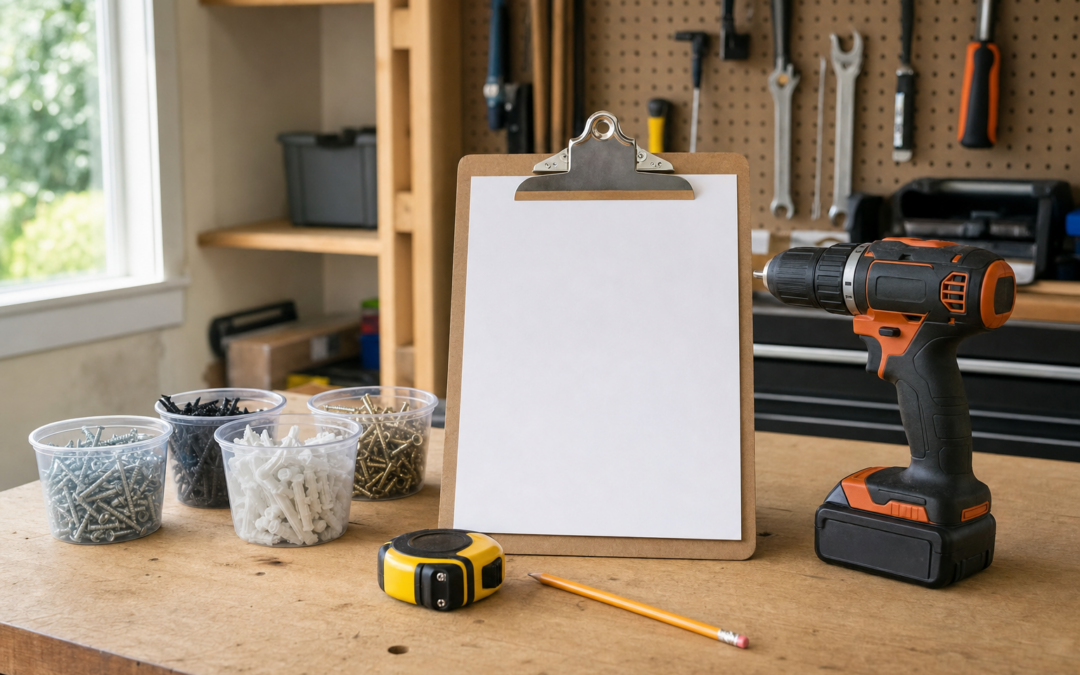
Most weekend DIY projects fail on Friday night planning—not on Sunday afternoon skill. You buy half the materials, discover a missing bit at 10 a.m., then burn the remaining daylight on a hardware-store loop. This guide is a practical planning system so you finish on Sunday with dry paint, square shelves, or a working outlet—and without a half-disassembled room waiting for next weekend.
Browse more homeowner tactics in our Tips & Advice hub. If your project needs power tools, start with our starter power tool kit for homeowners and the broader Power Tools hub. The sections below cover measurement, materials, tools, safety, and contingency so mid-job runs become rare.
Define “Done” Before You Open a Tool Bag
Write a one-sentence definition of done. “Guest bath walls painted two coats, trim cut in, hardware reinstalled, and floor protected until cure” beats “paint the bathroom.” Vague goals invite scope creep: suddenly you are also replacing the vanity light and caulking the tub.
List exclusions on the same card. Not this weekend: ceiling, door, or vanity. Constraints create finish lines. Share the definition with anyone helping so Saturday morning does not become a redesign meeting.
Photograph the “before” with wide shots and close-ups of problem areas. You will need them for hardware reinstall order, paint touch-up notes, and the rare return conversation.
Measure Twice, Buy Once: The Friday Night Ritual
Measure the space with a steel tape, not memory. Record height, width, and depth; note outlet and switch locations; mark studs if fastening is involved. For paint, calculate wall area minus large openings, then add 10 percent for cut-in waste and touch-ups. For shelving, measure the parking envelope with cars in place—empty-bay optimism is how racks kiss mirrors.
Create a materials list with quantities, finish, and size in the same units the store uses. Add consumables: painter’s tape, drop cloths, fasteners, blades, sandpaper grits, outlet testers batteries if needed. Put specialty items (matching caulk color, specific bit sizes) at the top so you do not discover them after the big-box run.
Check what you already own. Half-full cans of primer, leftover screws, and a ladder that actually reaches the eaves save money and trips. Lay tools on a towel Friday night; missing pieces become Saturday’s first errand instead of Sunday’s crisis.
Build a Tool and Platform Checklist
Match tools to tasks, not to wishlist fantasies. A weekend shelf install needs a reliable drill/driver, level, stud finder, and correct bits—not a full framing kit. If you are still assembling a first cordless set, our starter power tool kit guide and best cordless drills for homeowners help you avoid orphan batteries. For fastener-heavy work, skim impact driver vs drill so you bring the right driver for lag screws versus delicate hardware.
Height access is a planning item, not an afterthought. Step stools fail for crown and exterior lights; extension ladders need footing plans and a spotter culture. Telescoping options shine when storage space is tight and the job is intermittent.
- Power: charged batteries, charger placement, extension cords rated for the tool
- Layout: pencil, tape, level, square, laser if you own one
- Protection: eye/ear/dust gear, gloves suited to the task
- Cleanup: vacuum, rags, trash bags, labeled containers for removed hardware
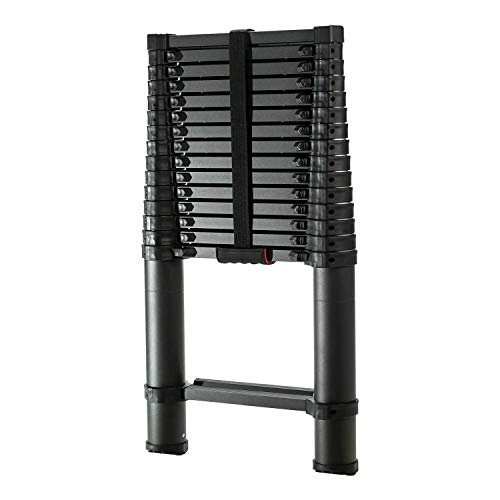
Xtend & Climb Contractor Series 155+/250 Telescoping ladder — A contractor-series telescoping ladder earns a planning slot when you bounce between interior high walls and outdoor fixtures—verify duty rating, lock indicators, and storage length against your actual ceiling heights before the weekend starts.
Safety and Electrical Reality Checks
Kill power at the breaker for any outlet, switch, or fixture work—and verify with a tester, not hope. Label the breaker with painter’s tape so nobody “helpfully” restores power mid-job. For wet-area or garage circuits, confirm GFCI behavior before and after work.
Structural and gas work are stop-lines for most DIY weekends. If your plan drifts into load-bearing questions, main panels, or gas lines, redefine done to “prep and hire” rather than improvising. Safety margins beat heroic finishes.
Keep a clear egress path. Drop cloths and sawhorses that block the only exit turn a small mishap into an emergency. Park a charged phone outside the dusty zone.

Klein Tools 80025 Outlet Tester Kit with GFCI Tester and Non-Contact — An outlet tester kit with GFCI and non-contact voltage detection belongs on the Friday checklist for any electrical weekend—verify dead circuits before you touch devices, then confirm correct wiring when you restore power.
Materials Staging and Workspace Setup
Stage materials in the order you will use them. Primer near the first wall, fasteners sorted by size, hardware in a labeled tray photographed before removal. Open paint cans and stir Friday night if temperatures allow; cold Saturday mornings waste warm-up time.
Protect floors and furniture before the first messy step. Canvas drop cloths stay put better than slick plastic under ladders. Move fragile items to another room entirely—covering in place invites accidents.
Lighting matters. Plug in a work light if the room’s only bulb is being replaced. Poor light causes missed holidays in paint and crooked shelves that look fine until Monday morning sun.
For broader tool shopping context beyond this weekend, see how to buy cordless power tools and browse Power Tools.
Time-Boxing Saturday and Sunday
Block Saturday for demolition, prep, and the irreversible steps (cutting, first coats, structural fasteners). Block Sunday for second coats, adjustments, cleanup, and punch list. Never schedule a first coat of paint for Sunday afternoon unless you accept mid-week curing in a live room.
Build in a hard stop for purchases: if a part is missing after 2 p.m. Saturday, decide whether the project can pause cleanly or must be re-scoped. Late-day big-box runs produce wrong-size returns and exhausted mistakes.
Hydration and meals are schedule items. Low blood sugar is how drill bits walk across finished floors.
Contingency: The “If This Breaks” List
Every project has a likely failure mode. Screws strip. Drywall crumbles. Paint color looks wrong in evening light. Pre-write the fallback: spare anchors, a small tube of spackle, a quart of the same paint for insurance, a plan to leave primer overnight if the first coat flashes unevenly.
Know the return window and keep receipts in a zip bag with the project card. Photograph packaging barcodes for online orders.
If weather matters (exterior caulk, stain, ladder work), check the forecast Friday and have an indoor alternate micro-project ready so the weekend still produces a win.
Common Weekend Planning Mistakes
Starting without a done definition. Skipping the tester on “simple” outlet swaps. Buying paint without a measured square footage. Assuming the ladder in the garage reaches. Inviting helpers without assigning roles. Leaving cleanup for “later tonight.” Cleanup is part of done; a dusty room with tools everywhere is an unfinished project that steals Monday.
Another quiet killer: underestimating cure and dry times. Read the can. Plan sleep and HVAC accordingly so you do not trap VOCs or imprint texture rollers into half-dry film.
Project-Type Mini Playbooks
Painting a room: follow a full checklist mindset—our painting room checklist and wall prep guide pair with this planning article. Garage storage: measure cars first; compare systems in garage shelving systems compared and ideas in best garage storage ideas. Smart devices: confirm Wi‑Fi and wiring before the unbox sprint; see smart home starter kit.
Pick one playbook per weekend. Mixing paint and electrical in the same eight-hour block is how both get compromised.
FAQ: Weekend DIY Planning
How long should planning take?
Forty-five focused minutes Friday beats three chaotic hardware runs Saturday. Complex projects deserve a mid-week measure night.
What if I only have one free day?
Shrink the definition of done. One excellent wall or one installed shelf unit outperforms a house-wide false start.
Do I need every tool on influencer lists?
No. Borrow or rent rare specialty tools; own the ones you use monthly. Start with the starter kit logic.
Where do I browse more tips?
Our Tips & Advice hub collects planning and how-to pillars across categories.
Next Steps
Write your done sentence, measure tonight, stage tools, and charge batteries. Put the tester and ladder decisions on the list before paint or fasteners. When you need deeper category help, jump from this tip into Power Tools, Painting, or Garage Storage as the project demands.
Sunday evening should feel like closing a loop—not opening a new unfinished wing of the house. Plan like a contractor; execute like a careful homeowner.
Keep the project card and photos in a maintenance album. Next weekend’s you will inherit clarity instead of mystery hardware bowls.
Explore more practical playbooks in the Tips & Advice section whenever a project starts whispering “this will be quick.”
Additional Homeowner Notes
Keep receipts, manuals, and phone photos of model numbers in a dedicated home maintenance album. When a replacement part, warranty claim, or future remodel needs exact identity, that album beats guesswork. Add a calendar reminder to recheck fasteners, seals, filters, or caulk on a seasonal cadence appropriate to the project.
If family members or contractors help, leave a one-page note: shutoff locations, Wi‑Fi details for smart devices, paint codes, and which account owns an app. Clear handoffs prevent irreversible mistakes.
Prefer listed products, correct structural anchors, and manufacturer-approved kits over mystery adapters. Compatibility shortcuts are how returns and service calls start.
Revisit linked pillars and full product reviews before you buy—tips choose approaches, but deep pages carry install caveats and updated kit contents that change over time. Return to the Tips & Advice hub whenever the next project starts to sprawl.
Additional Homeowner Notes
Keep receipts, manuals, and phone photos of model numbers in a dedicated home maintenance album. When a replacement part, warranty claim, or future remodel needs exact identity, that album beats guesswork. Add a calendar reminder to recheck fasteners, seals, filters, or caulk on a seasonal cadence appropriate to the project.
If family members or contractors help, leave a one-page note: shutoff locations, Wi‑Fi details for smart devices, paint codes, and which account owns an app. Clear handoffs prevent irreversible mistakes.
Prefer listed products, correct structural anchors, and manufacturer-approved kits over mystery adapters. Compatibility shortcuts are how returns and service calls start.
Revisit linked pillars and full product reviews before you buy—tips choose approaches, but deep pages carry install caveats and updated kit contents that change over time. Return to the Tips & Advice hub whenever the next project starts to sprawl.
Additional Homeowner Notes
Keep receipts, manuals, and phone photos of model numbers in a dedicated home maintenance album. When a replacement part, warranty claim, or future remodel needs exact identity, that album beats guesswork. Add a calendar reminder to recheck fasteners, seals, filters, or caulk on a seasonal cadence appropriate to the project.
If family members or contractors help, leave a one-page note: shutoff locations, Wi‑Fi details for smart devices, paint codes, and which account owns an app. Clear handoffs prevent irreversible mistakes.
Prefer listed products, correct structural anchors, and manufacturer-approved kits over mystery adapters. Compatibility shortcuts are how returns and service calls start.
Revisit linked pillars and full product reviews before you buy—tips choose approaches, but deep pages carry install caveats and updated kit contents that change over time. Return to the Tips & Advice hub whenever the next project starts to sprawl.
Additional Homeowner Notes
Keep receipts, manuals, and phone photos of model numbers in a dedicated home maintenance album. When a replacement part, warranty claim, or future remodel needs exact identity, that album beats guesswork. Add a calendar reminder to recheck fasteners, seals, filters, or caulk on a seasonal cadence appropriate to the project.
If family members or contractors help, leave a one-page note: shutoff locations, Wi‑Fi details for smart devices, paint codes, and which account owns an app. Clear handoffs prevent irreversible mistakes.
Prefer listed products, correct structural anchors, and manufacturer-approved kits over mystery adapters. Compatibility shortcuts are how returns and service calls start.
Revisit linked pillars and full product reviews before you buy—tips choose approaches, but deep pages carry install caveats and updated kit contents that change over time. Return to the Tips & Advice hub whenever the next project starts to sprawl.
Additional Homeowner Notes
Keep receipts, manuals, and phone photos of model numbers in a dedicated home maintenance album. When a replacement part, warranty claim, or future remodel needs exact identity, that album beats guesswork. Add a calendar reminder to recheck fasteners, seals, filters, or caulk on a seasonal cadence appropriate to the project.
If family members or contractors help, leave a one-page note: shutoff locations, Wi‑Fi details for smart devices, paint codes, and which account owns an app. Clear handoffs prevent irreversible mistakes.
Prefer listed products, correct structural anchors, and manufacturer-approved kits over mystery adapters. Compatibility shortcuts are how returns and service calls start.
Revisit linked pillars and full product reviews before you buy—tips choose approaches, but deep pages carry install caveats and updated kit contents that change over time. Return to the Tips & Advice hub whenever the next project starts to sprawl.
Additional Homeowner Notes
Keep receipts, manuals, and phone photos of model numbers in a dedicated home maintenance album. When a replacement part, warranty claim, or future remodel needs exact identity, that album beats guesswork. Add a calendar reminder to recheck fasteners, seals, filters, or caulk on a seasonal cadence appropriate to the project.
If family members or contractors help, leave a one-page note: shutoff locations, Wi‑Fi details for smart devices, paint codes, and which account owns an app. Clear handoffs prevent irreversible mistakes.
Prefer listed products, correct structural anchors, and manufacturer-approved kits over mystery adapters. Compatibility shortcuts are how returns and service calls start.
Revisit linked pillars and full product reviews before you buy—tips choose approaches, but deep pages carry install caveats and updated kit contents that change over time. Return to the Tips & Advice hub whenever the next project starts to sprawl.
Additional Homeowner Notes
Keep receipts, manuals, and phone photos of model numbers in a dedicated home maintenance album. When a replacement part, warranty claim, or future remodel needs exact identity, that album beats guesswork. Add a calendar reminder to recheck fasteners, seals, filters, or caulk on a seasonal cadence appropriate to the project.
If family members or contractors help, leave a one-page note: shutoff locations, Wi‑Fi details for smart devices, paint codes, and which account owns an app. Clear handoffs prevent irreversible mistakes.
Prefer listed products, correct structural anchors, and manufacturer-approved kits over mystery adapters. Compatibility shortcuts are how returns and service calls start.
Revisit linked pillars and full product reviews before you buy—tips choose approaches, but deep pages carry install caveats and updated kit contents that change over time. Return to the Tips & Advice hub whenever the next project starts to sprawl.