
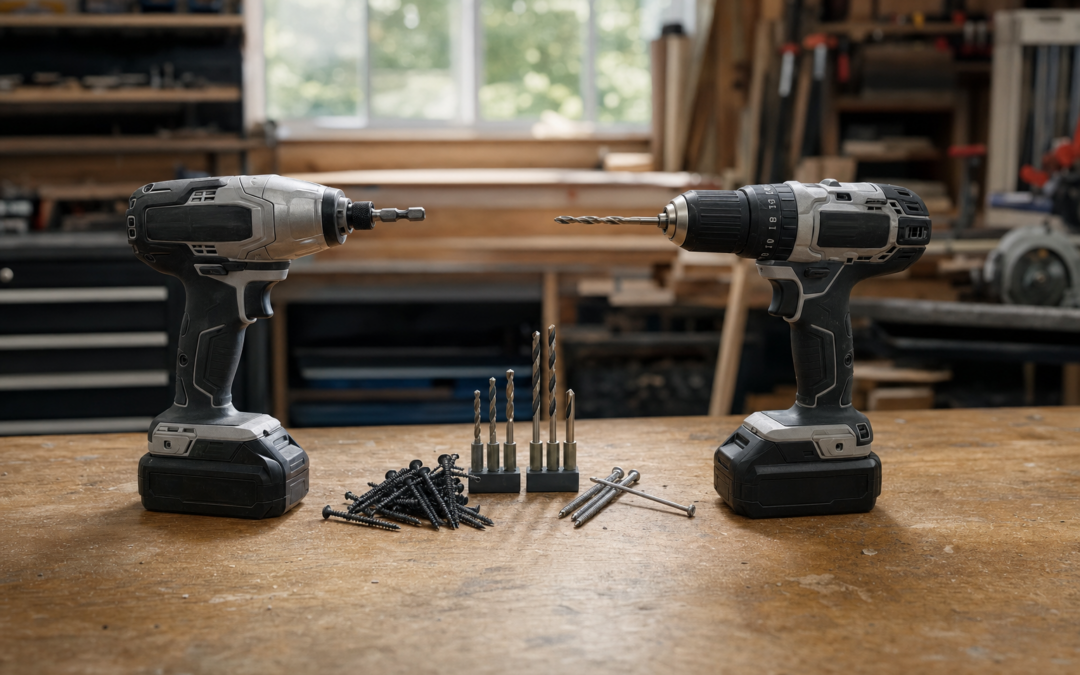
Stripped screws, cammed-out bits, and smoked drill motors usually share a cause: using a drill for a high-volume driving job—or using an impact where a clutch-controlled drill would protect the work. This 2026 guide separates impact drivers from drill/drivers so you know when to use each tool, how hex bits differ from keyed or keyless chucks, and how to build a small cordless kit without duplicate mistakes.
For wider tool planning, see our Power Tools hub. Here the focus is roles, fasteners, and combo logic.
Drill/Driver: Holes, Clutch Control, and Versatility
A drill/driver uses a chuck that clamps round-shank bits and many hex accessories. The clutch ring slips at a set resistance so you can drive screws without always punching through soft material. Two-speed gearboxes split drilling and driving. This is the generalist: anchors, pilot holes, furniture screws, mixing small compounds with a paddle (carefully), and sanding drums on a chuck.
- Use a drill when: you need holes, delicate assembly, adjustable clutch, or round bits
- Watch outs: wrist torque reaction on big fasteners, slower on long deck screws, bit cam-out if you lean askew
Impact Driver: Fastening Specialist
An impact driver delivers rotational hits that help drive long fasteners with less perceived wrist twist. It typically uses a 1/4-inch hex collet—not a three-jaw chuck—so you grab hex-shank driver bits and hex drill bits. There is usually no clutch ring like a drill; control comes from trigger modulation, mode settings on some models, and bit selection.
- Use an impact when: driving lots of screws into wood, working with structural screws, or freeing stubborn fasteners
- Watch outs: overdriving finish hardware, polishing screw heads with the wrong tip, poor performance with round-shank bits unless adapted
Hex vs Chuck in Plain Language
Chucks are flexible. Hex collets are fast. If your day is drilling 3/8-inch holes with inexpensive black oxide bits, the drill wins. If your day is three-inch deck screws with Torx tips, the impact wins. Adapters exist to put hex bits in chucks and some round bits in impacts, but adapters are compromises—prefer the native system for daily work.
Keep separate bit assortments: a drill index for the chuck, and impact-rated driver bits for the hex collet. Impact-rated bits tolerate the hammering; brittle glass-hard bits can shatter.
Deck Screws vs Holes: A Decision Shortcut
Ask one question before you pull a trigger: Am I making a hole or seating a fastener?
- Hole: drill/driver (or hammer drill for masonry)
- Fastener into wood, especially long: impact driver
- Fastener into soft furniture particleboard: drill with low clutch
- Machine screws into metal inserts: drill or hand tools—impacts can trash threads
Predrilling still matters with impacts. Impacts make it easy to skip pilots and split boards near ends. Speed is not a license to ignore wood movement and grain.
Combo Kits and Platform Planning
Drill + impact combo kits are popular because the tools share batteries and the roles complement each other. If you must buy one tool today, buy the drill first—you can make holes and drive light screws. Add the impact when screw count climbs.
If you already own a strong drill and hate deck days, add a bare impact on the same platform. Avoid a second orphan battery chemistry just because a combo was on sale in another brand.
Product Callouts: Impact and Drill Options We Review
Pair a dedicated impact with solid homeowner drill kits across major platforms. Use the impact for driving volume; keep the drills for clutch work and holes.

Makita XDT11Z 18V LXT Lithium-Ion Cordless Impact Driver — Compact 18V LXT impact driver (tool only) for Makita platform users who want hex-bit driving speed for deck screws and lags without turning every hole-drilling task into an impact job.

DEWALT 20V MAX* Cordless Drill/Driver Kit with Screwdriver/Drill Bit Set — Full DEWALT 20V drill/driver kit with bits—the control side of the pairing when you need a chuck, clutch, and accessories in one homeowner-ready box.

Milwaukee M18 18V Lithium-Ion 1/2 Inch Cordless Drill Driver Compact Kit 2606 — Milwaukee M18 compact drill kit energy for households standardizing on M18; keep this for holes and assembly while an impact handles repetitive driving.

RYOBI ONE+ 18V Cordless 1/2in Drill/Driver PCL206B (Tool Only) — Ryobi ONE+ bare drill for ecosystem shoppers—pair later with a ONE+ impact once batteries and charger are already on the shelf.
Technique Tips That Prevent Stripped Hardware
- Match tip geometry exactly—Torx for Torx, square for square; worn Phillips is a strip kit
- Seat the bit fully before pulling the trigger
- Start screws slow to avoid angle skate
- Finish the last millimeters carefully—especially with impacts on soft trim
- Back out if you smell hot clutch or see mushroomed heads
For finish work, many pros still set delicate hardware by hand after the impact runs the screw most of the way. Ego-driving every hinge screw with full trigger is how doors stop closing squarely.
Noise, Vibration, and Jobsite Manners
Impacts are louder and send more vibration into the hand. Hearing protection is not optional on long deck runs. Inside a finished house, the hammering sound carries—schedule noisy driving when it will not wake the entire floor, or switch to a drill with clutch for light indoor screws.
Building a Small Two-Tool Kit
- Choose one battery platform
- Own a compact drill/driver with clutch
- Add a compact impact driver
- Stock impact-rated driver bits and a small drill index
- Keep two batteries in rotation
That kit covers the majority of home fastening and hole-making. Circular saws and sanders come next based on project mix—not before you can drive a screw without drama.
Myths Worth Retiring
- “Impacts replace drills.” They replace drills for many driving tasks, not for general drilling with round bits.
- “More torque is always better.” Uncontrolled torque destroys work. Modes and trigger control matter.
- “Any bit is fine in an impact.” Use impact-rated bits; protect your eyes from shattered tips.
- “Drills are obsolete.” Clutch control and chuck versatility keep drills essential.
Maintenance Notes
Blow dust from vents, wipe hex collets, and replace worn bit tips early. Store packs partially charged if the manufacturer recommends it for long storage, and avoid baking batteries in hot cars. A sticky chuck jaw on the drill is a cleaning issue—do not force it.
Project Playbooks
Building a backyard deck
Impact for screws; drill for pilots and any hole-mounted hardware. Keep spare bits—deck work eats tips.
Assembling cabinets
Drill with low clutch for confirmat or wood screws into composite materials. Impacts are optional and risky on soft panels.
Mounting a TV
Drill for anchors and lag pilot holes; controlled driving for lags—many people prefer a drill or even a ratchet for final lag seating to avoid crushing the bracket.
Fence boards
Impact for volume; drill for posts and specialty hardware. Predrill brittle cedar near ends.
Fastener Science for Normal Humans
Screws fail by stripping heads, snapping shanks, or blowing out material. Impacts reduce cam-out on many modern Torx and square-drive fasteners because the hammering action keeps the tip engaged while the screw advances. That does not mean every fastener wants an impact. Brass screws, soft hinge screws, and tiny electronics-adjacent hardware prefer hand tools or low-clutch drills.
Structural screws and lags have manufacturer pilot-hole charts. Follow them. An impact can drive a lag into an undersized hole until something cracks—sometimes the wood, sometimes the fastener, sometimes your schedule when a post split shows up later.
Self-drilling metal screws still need correct tips and pressure. Impacts help, but the wrong screw in thick steel just polishes a dimple and hardens your mood.
Mode Switches, Pulse Settings, and Soft-Start Habits
Newer impacts often include modes that reduce speed or pulse near the end of driving. Use them around finish work. If your impact has only a trigger, practice feathering on scrap until you can stop a screw flush without cratering. Drills teach clutch numbers; impacts teach trigger discipline.
Some drills include hammer-drill modes for masonry. That mode is not an impact driver. Hammer drills punch axially for masonry bits; impact drivers hammer torsionally for fasteners. Using the wrong mode wastes time and damages bits.
Bit Storage and Job Pouch Logic
Keep impact bits in a small pouch clipped to the bag you take outside. Keep drill bits in a labeled index in the shop. Mixing them in one coffee can guarantees the wrong tip at the wrong time. Magnetic trays help on ladders but spill spectacularly—use them on the ground or bench.
Color-code platforms if your household somehow owns two chemistries: colored tape on tools and packs reduces grab-the-wrong-battery mistakes. Better yet, do not own two chemistries.
Body Mechanics and Injury Prevention
Impacts reduce reactive torque but add vibration. Take breaks on long deck runs. Support your wrist; do not hyperextend to reach awkward fence angles—move your feet. On drills, brace your body so a bind in the bit does not twist your shoulder. Remove rings that can catch on spinning chucks.
Eye protection matters when bits shatter or coated screws throw chips. It feels optional until the first near-miss.
Buying Checklist Before You Click Add to Cart
- Do I already own a drill with clutch? If no, buy drill first.
- Do I already own the battery platform? If yes, buy bare impact.
- Do I drive long screws monthly? If yes, prioritize impact sooner.
- Do I assemble furniture weekly? If yes, prioritize drill clutch feel.
- Can I buy impact-rated bits the same day? If no, wait—do not use glass-hard non-impact bits.
Price the true kit: tool, batteries, charger, and bits. A “cheap” impact that needs two packs and a charger is not cheap. Align with the drill platform you trust.
Teaching Household Members the Difference
Put a note on the impact: “screws.” Put a note on the drill: “holes + gentle screws.” It sounds silly until a guest uses the impact on particleboard shelf pins. Short labels prevent long repairs. Demonstrate clutch chatter once so people recognize it as a feature, not a broken gearbox.
Field Notes From Real Garage Constraints
Real garages are cold in winter, hot in summer, and short on outlets. Plan extension cords rated for the tool load, keep cords out of blade paths, and do not run undersized cords that starve motors. Seasonal humidity warps lumber stored on concrete—sticker your boards and let them acclimate before critical cuts or finish sanding.
Lighting changes perceived quality. Add a bright shop light before you blame tools for wandering holes or missed layout lines. A $30 lighting improvement often upgrades every tool you already own. Keep a broom and vac habit so sawdust does not turn into a slip plane under a miter stand.
When storage is tight, vertical holsters and wall hooks beat floor piles. A charged battery on a known shelf is a project multiplier; a buried kit under holiday bins is how DIY weekends die. Revisit your layout each season as projects change—deck season wants different access than interior paint season.
Finally, write down what you bought and why. Six months later you will forget which battery platform you chose and why the corded sander was intentional. A simple note in your phone prevents duplicate purchases when a flashy kit goes on sale in a competing chemistry.
Jobsite Sequencing When You Own Both Tools
On a deck day, many DIYers keep the impact on a belt hook and the drill on a sawhorse for pilots. Predrill a run of boards, then drive. Trying to switch bits in one tool fifty times is how afternoons vanish. Two tools earn their keep through fewer changeovers, not through mystique.
Indoors, reverse the bias: leave the impact in the tote until you hit a stubborn lag or a long construction screw. Most hanging and assembly tasks are safer with clutch control. If you hear the impact’s hammering on a delicate cabinet install, ask whether you chose the tool out of habit.
Battery swaps mid-task are less annoying when both tools share packs. Park the charger near the work zone on big days. A third battery is a luxury that becomes reasonable once both tools are weekly drivers—otherwise two packs and a lunch-break charge cycle still works.
When lending tools to friends, send the matching bits. An impact without impact-rated tips becomes a screw-head destroyer in someone else’s hands, and you will inherit the blame when they return the tool with a shrug.
Keep written cut lists and fastener counts before shopping days. Overbuying specialty screws “in case” clutters bins; underbuying mid-project wastes momentum. A simple notepad in the kit tote prevents both. Review manufacturer instructions for each tool once, then store manuals digitally so the paper copies can live in a single envelope instead of scattering.
FAQ: Impact Driver vs Drill
Can I drill holes with an impact driver?
Yes with hex-shank drill bits, within reason. For frequent hole-making and larger diameters, a drill/driver is the better tool.
Can I drive deck screws with a drill?
Yes, especially with sharp bits and patience. An impact is faster and easier on the wrist for big counts.
Which should I buy first?
Buy the drill first if you own neither. Add the impact when fastening volume grows.
Do I need a combo kit?
Combos are convenient if you need both and lack batteries. Otherwise buy bare tools onto an existing platform.
Why did my impact strip a screw?
Wrong tip, worn tip, angled driving, or too much speed at the end of travel. Fix technique before blaming the tool.
Next Steps
Sort your upcoming tasks into holes vs fasteners. Keep clutch drilling for precision; reach for the impact when screw count and length climb. Compare the reviewed tools above and standardize on one battery family.
More cordless options live in our Power Tools hub. Stop stripping screws by matching the tool to the job—not by squeezing a drill harder and hoping.