
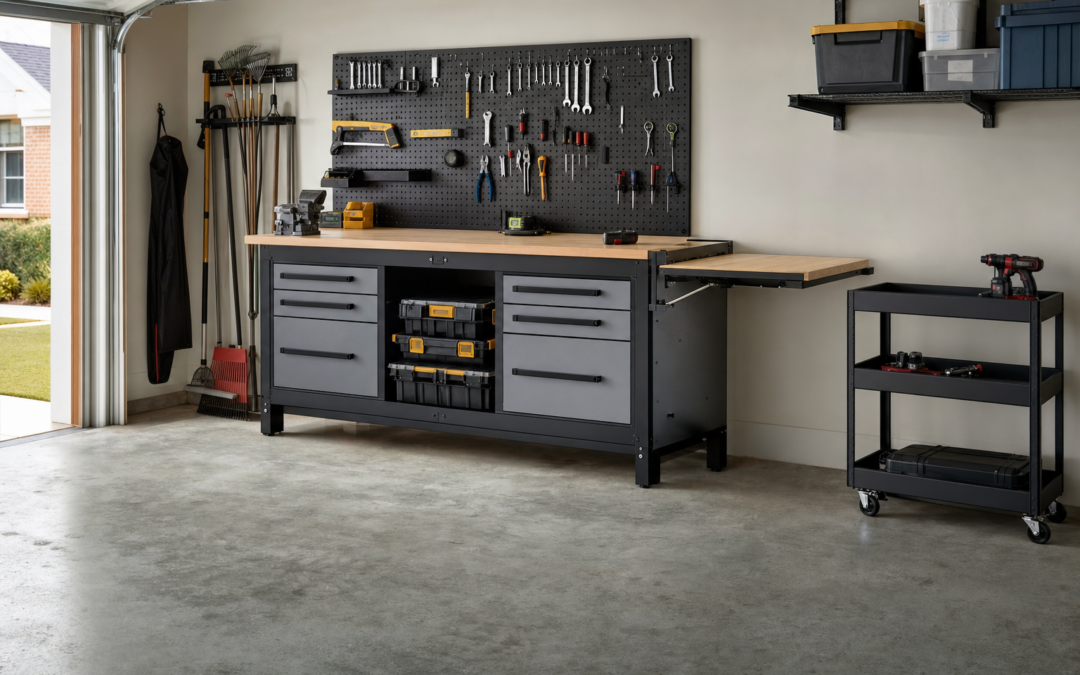
A garage workbench is storage strategy disguised as a table. Without a defined project surface, repairs migrate onto washer lids, car hoods, and the only clear strip of concrete you still had. With the right bench—folding, rolling, or fixed with drawers—you gain a home base for tools, fasteners, and half-finished projects that would otherwise colonize the parking envelope. This 2026 guide shows how to build a workbench storage setup that respects cars, power, and real DIY habits.
For whole-garage planning, use our Garage Storage hub and the garage storage ideas pillar. Here we zoom into the work zone: bench styles, drawer logic, power access, and reviewed options that fit one- and two-car garages.
Why the Workbench Is a Storage Hub
Tools without a bench become orphans. Orphans become grocery-bag kits. Grocery-bag kits become purchases of duplicates. A bench breaks that loop by giving daily tools a gravitational center: pegboard or rail above, drawers below, project surface in the middle, and a rule that the top clears when the car needs the bay.
Storage around the bench matters as much as the top. Fasteners in labeled bins beat coffee cans. Chargers need outlets that are not halfway across the garage. Hazardous adhesives and solvents still belong in a lockable cabinet—not in an open cubby a child can reach while you cut a board.
Folding vs Rolling vs Fixed: Choose the Behavior, Not the Catalog Photo
Folding / wall-mounted benches
Best when parking is non-negotiable. Fold down for a Saturday project, fold up so the vehicle envelope returns. Ideal for one-car garages and shared family spaces where a permanent bench would permanently delete a stall.
Limits: less mass for heavy pounding, fewer integrated drawers unless you add nearby storage, and you must mount into studs correctly. Treat the wall structure as part of the product.
Rolling workbenches
Best when you need the bench near the driveway for messy cuts, then parked against a wall. Lock casters before you lean, clamp, or hammer. Drawers on a rolling chassis can replace a small tool chest if organized well.
Limits: rolling under heavy load into a sloped slab can drift. Keep aisles clear. Do not treat unlocked casters as a feature during precision work.
Fixed heavy-duty benches
Best when the workshop zone is permanent and parking is already solved. Maximum stability, easiest to add vise, lighting, and overhead power. Pair with wall cabinets or pegboard for a complete bay.
Limits: permanent footprint. Measure twice so you do not build a beautiful bench that forces a car to live outside all winter.
Parking Clearance: The Measurement People Skip
Tape the vehicle footprint including door swing. Then stage the bench outside that tape—or choose folding so the tape can reclaim the space. Check refrigerator-depth appliances and trash cans that also compete for the same wall. A bench that fits in a brochure still fails if the dryer door and the truck door both need the same air.
Height and reach matter too. You should access drawers without standing in the vehicle envelope. If the bench is behind a parked bumper, daily tool access will die within a week.
Power, Light, and the “Two-Trip” Rule
Every extra trip across the garage to find an outlet or a bit set is a tax on finishing projects. Prefer benches with integrated outlets and light when your wall wiring is awkward—or plan a safe, code-conscious outlet addition rather than daisy-chaining cheap strips forever.
- Bright task lighting over the surface
- Outlets for chargers and small tools
- Cord management so cables are not trip lines
- A small trash bin within one step
- Fire extinguisher still visible—not buried behind the rolling bench
Follow the two-trip rule: if starting a 20-minute fix requires more than two trips to gather tools, your storage layout is wrong.
Drawer and Wall Storage That Keeps the Top Clear
The bench top is for the current project, not permanent inventory. Put daily hand tools on a pegboard or rail. Put fasteners in shallow drawers or compartment boxes. Put power tools in deeper drawers or a nearby cabinet. Put chemicals in a lockable cabinet away from the spark zone when required.
Label drawer fronts. Shadow-board outlines help families return tools. Leave one empty drawer as a “project in progress” catcher so random parts do not claim the top.
Product Callouts: Workbenches We Review
Compare folding, rolling, powered, and drawer-centric options below. Open each review for dimensions and who the bench fits.

Wallmaster Wall Mounted Folding Workbench Heavy Duty Fold Down Table — Wall-mounted folding design for garages where the floor belongs to cars most of the week. Mount into studs, fold down for projects, fold up to reclaim the bay.

Rumetol 55″W Heavy Duty Rolling Workbench with Drawers and Storage — A wider rolling workbench with drawers when you need mobility plus integrated storage—lock the casters before serious work and park it clear of door swing.

48″ Heavy Duty Workbench with Drawers and Lockable Storage Cabinet- 2500 — Heavy-duty bench thinking with drawers and lockable storage for households that want the work surface and secure tool storage in one footprint.
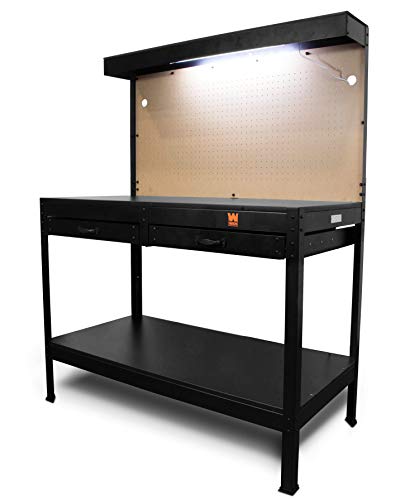
WEN WB4723T 48-Inch Workbench with Power Outlets and Light — A 48-inch class bench with power outlets and light when your biggest friction is chasing electricity and illumination across a dark garage wall.
Build-Out Recipes by Garage Type
One-car / tight shared garage
Folding wall bench + pegboard + one lockable cabinet for hazards + a single wire rack for bins. No permanent deep bench unless you have truly abandoned parking.
Two-car with a dedicated workshop strip
Fixed or rolling drawer bench on the far long wall, cabinets for tools, wire shelving for household overflow on the opposite side, overhead racks for seasonal bulk. Keep the center aisle sacred.
DIY-heavy household
Rolling bench for driveway-adjacent cuts, fixed secondary surface if space allows, serious drawer organization, and disciplined chemical storage. Add dust rules so the “workshop” does not coat every tote on the open shelves.
Workflow Habits That Make Hardware Worth It
- End every session by clearing the top
- Return tools to silhouettes or labeled drawers
- Bag scraps that are not a real future project
- Charge batteries on the bench outlets, not on the washing machine
- Keep a permanent home for the tape measure and pencil—lost basics kill momentum
Photograph the ideal bench reset once. When the surface looks like a yard sale, restore to the photo instead of inventing a new system every month.
Safety Around Work Zones
Eye protection within arm’s reach. No cords across walking lanes. Clamp workpieces—do not freehand against hope. Keep solvents in proper containers inside a cabinet. If you weld or grind, protect cars and flammables with real distance and shields, not vibes.
Folding benches must be fully supported per design before load. Rolling benches must have casters locked. Fixed benches should not block egress. Organization that traps you in a corner during an emergency is not organization.
Budget Sequencing for Workbench Storage
- Decide folding vs rolling vs fixed based on parking reality
- Buy the bench that matches that reality
- Add pegboard/rail and fastener organization immediately
- Add lockable chemical storage if it does not exist yet
- Upgrade lighting and power once the footprint is proven
Skip decorative upgrades until the bench is actually clearing projects off the car hood. Function first.
Fastener Systems That Stop the Coffee-Can Habit
Most DIY friction is fasteners, not framing. A workbench storage setup should make #8 screws, machine bolts, wall anchors, and drill bits findable in seconds. Use compartment boxes with large labels, or drawer organizers with one category per drawer. Avoid opaque unmarked containers stacked three deep.
Keep a “consumables top-off” list taped inside a drawer: screws you always need, painter’s tape, glue, blades. When you empty a pack, write it down immediately. This is boring. It is also how projects finish on Saturday instead of dying on Sunday at the big-box store.
Separate construction fasteners from automotive fasteners if you do both. Mixing systems creates wrong-length chaos. If you share the bench with another adult, agree on the label language once and enforce it kindly but consistently.
Pegboard, Tracks, and French Cleats
Wall systems above the bench multiply usable storage without growing the footprint. Pegboard is inexpensive and flexible. Slatted track systems look cleaner and handle heavier hooks. French cleats are customizable for odd tools. Pick one primary system for the main wall so hooks and holders are interchangeable.
Hang daily tools at eye level: hammer, drivers, square, utility knife, pliers. Put rarely used specialty tools higher or in drawers. Outline silhouettes if multiple people use the space. Do not hang so many tools that you cannot set a workpiece against the wall occasionally—leave a clear backer zone.
Dust, Noise, and Neighbor Reality
A workbench encourages cutting and sanding—which encourages dust on every open shelf nearby. If your garage uses open wire heavily, place a cheap zipper dust curtain or accept that tote lids are mandatory. Sweep or vacuum after dusty sessions before dust becomes a permanent texture on stored goods.
Noise travels. If you share walls with living space or neighbors, schedule louder work and add simple soft pads under rolling benches so they do not rumble across concrete at dawn. Organization includes social peace, not just tool peace.
Electrical Safety Without the Lecture Tone
Integrated outlets on benches are convenient. They are not an excuse for octopus adapters and undersized extension cords. Use cords rated for the tool, keep them out of walk lanes, and retire damaged jackets. If you repeatedly trip breakers, stop and fix the circuit plan—do not normalize nuisance trips as “normal workshop life.”
Task lighting should be secured so it cannot fall onto a spinning blade. Magnetic LED bars and properly mounted shop lights beat clamp lamps that migrate. Illuminate drawers too; dark drawers become junk drawers.
Project Staging Without Colonizing the Car Bay
Define a staging rectangle: lumber short-term storage, a sawhorse set, or a rolling cart that parks beside the bench. When the project pauses mid-week, stage inside that rectangle—not across the parking envelope. If the rectangle is full, you are not ready for a new project. Finish or break down first.
Use scrap rules: keep only scraps longer than a written threshold, store them in one vertical bin, and purge monthly. Scrap without rules becomes a second floor.
Choosing Among the Reviewed Benches
If cars must win most days, start with the wall-mounted folding option and build pegboard around it. If you move between driveway and wall, prioritize a rolling drawer bench and religious caster locking. If you have a permanent workshop strip and want fewer trips for power, consider a bench with outlets and light. If you need secure tool storage in the same footprint, favor designs with drawers and lockable compartments—and still keep true chemicals in a dedicated hazard cabinet when appropriate.
Re-read dimensions against your tape measurements. The best bench on the internet is the wrong bench if it permanently deletes your ability to park.
Weeknight Repair Kit: Designing for Fifteen-Minute Jobs
Most household repairs are short: tighten a hinge, swap a filter, assemble a kid’s toy, fix a loose shelf. Your workbench storage should optimize those fifteen-minute jobs. Keep a shallow tray of the true everyday drivers, hex keys, tape, and utility knife permanently ready. Put specialty tools one step farther away. If starting a tiny job requires excavating a deep drawer, you will do the job on the kitchen counter instead—and the garage system will atrophy.
Create a “return path” habit: tools leave the tray or pegboard and must return before the bench top is declared clear. Pair that with a small parts dish for screws removed mid-repair so they do not vanish into concrete cracks.
Integrating the Bench With Shelves, Cabinets, and Ceiling Racks
The bench is one node in the garage network. Wire shelves feed it with project materials. Cabinets protect the chemicals it should not host long-term. Overhead racks keep seasonal bulk from invading the work strip. When those layers are missing, the bench becomes a junk altar because it is the only horizontal surface left.
Plan adjacency: fasteners and hand tools within one step; power tools within two; bulk lumber or totes within a short carry; hazards behind a lock. If retrieving epoxy requires a scavenger hunt through open sports bins, your zones are lying to you.
Revisit the layout after thirty days of real use. Move the pegboard hooks that you never reach. Demote tools that were wishful thinking. The best workbench storage setup is the one your hands vote for—not the one that looked complete on install day.
Install Day Checklist
Clear the bay, verify studs or decide rolling placement, assemble per instructions, lock casters or confirm fold braces, mount pegboard, load drawers with labeled fastener boxes, test outlets and lights, and photograph the reset state. Do a fifteen-minute practice repair the same day so you immediately discover missing basics—pencil, tape measure, and a trash can—before the system hardens around gaps.
FAQ: Garage Workbench Storage
Is a folding workbench strong enough?
For many household DIY tasks, yes—when mounted correctly into studs and used within rated limits. For heavy pounding or massive vises, a fixed or heavy rolling bench is happier. Read the specific model review.
Do I need drawers or is pegboard enough?
Pegboard is great for daily hand tools. Drawers win for fasteners, blades, and power-tool kits. Most people benefit from both.
What size workbench fits a two-car garage?
Often a 48–55 inch width along a side wall works if depth stays outside door swing. Measure your envelope; do not copy a stranger’s layout blindly.
Should a workbench have power outlets?
Integrated power and light reduce friction if wall outlets are scarce. Still use safe cords and avoid overloading circuits. When in doubt, consult an electrician for new receptacles.
Where do chemicals go in a workbench setup?
In a lockable cabinet, not in an unlocked cubby under the bench if kids or pets share the space. The bench organizes work; it does not absolve hazard storage rules.
Next Steps
Decide whether your bench must disappear for parking. Measure the vehicle envelope. Pick folding, rolling, or fixed from the reviews above, then build drawer and wall storage that keeps the top clear.
Continue through our Garage Storage hub for shelves, cabinets, and ceiling racks that support the same clean-floor goal. A workbench worth owning is one that makes the next small repair easier—and keeps the cars where they belong.