
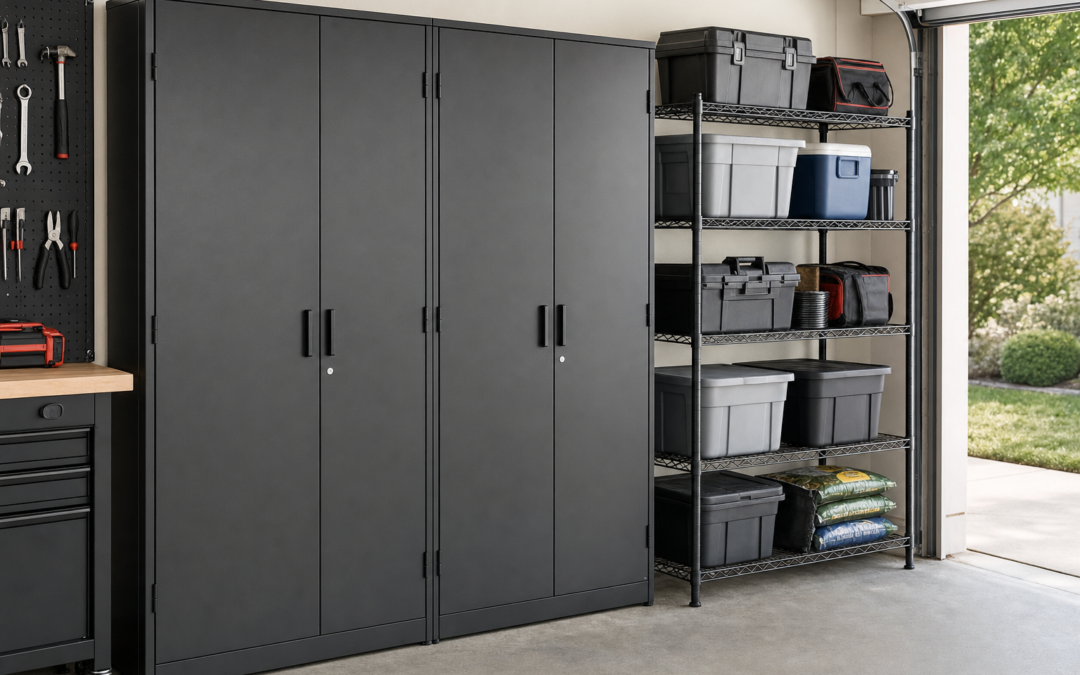
Open shelving shows you everything. Cabinets hide everything. Most garages need both—but buying in the wrong order wastes money and still leaves chemicals at kid height on a wire rack. This guide compares garage cabinets versus open shelving for dust control, safety, cost, visual calm, and daily usability, then shows hybrid wall plans that actually match how suburban households park, tinker, and store seasonal overflow.
Cross-link the rest of your system through our Garage Storage hub and the 2026 garage storage ideas guide. Below is the decision framework: when closed storage wins, when open wire wins, and which reviewed cabinets deserve a look.
The Core Tradeoff in One Minute
Open shelving maximizes visibility and airflow. You grab a labeled tote without opening doors. Cabinets maximize containment: less visual clutter, better dust control, and lockable storage for hazards. Neither replaces the other for a complete garage.
- Choose open shelves for: sealed bins you open weekly, bulky household overflow, items that benefit from being seen
- Choose cabinets for: chemicals, sharp tools, dusty power-tool accessories, anything you want out of sight or locked
- Choose both when: you have kids/pets, you care about a finished look, and you still need fast bin access
Open Shelving: Pros, Cons, and Best Uses
Pros
Speed and honesty. Labels face the aisle. You notice inventory before you buy duplicates. Wire shelves are usually cheaper per cubic foot than full cabinet walls. Humidity and dust do not trap the same way they can inside cheap particleboard boxes.
Cons
Visual noise. Everything on display can make a garage feel messy even when it is categorized. Open shelves are the wrong home for pesticides, fuels, and breakables at child height. Small parts need bins; they will not sit neatly on wire alone.
Best open-shelf jobs
Weekly sports totes, paper goods, camping bins between trips, and household overflow that is sealed and labeled. Pair with overhead racks for true seasonal archive so the open wall does not become a forever pile.
Garage Cabinets: Pros, Cons, and Best Uses
Pros
Doors create calm. Locks create safety. Enclosed boxes reduce dust on tools and keep chemicals from becoming “interesting” to kids and pets. A matched cabinet run can make a garage feel like a finished room instead of a storage unit with a car in it.
Cons
Higher cost per foot. You must open doors to see inventory—so unlabeled cabinets become mystery closets. Poorly built cabinets sag, swell, or rust in unconditioned spaces. Depth still has to respect door swing and vehicle clearance.
Best cabinet jobs
Fertilizers, solvents, automotive chemicals, sharp blades, and tools you want dust-controlled. Also ideal for households staging the garage as a semi-finished entry zone where open clutter would dominate the view from the house door.
Safety: The Argument Cabinets Often Win
If you store lawn chemicals, fuels, or strong cleaners, open wire at kid height is a safety fail regardless of how neat the labels look. A lockable cabinet—or at least a lockable utility cabinet—belongs in the plan early, not after you finish the pretty wall.
Keep cabinets away from ignition sources when storing flammables, follow container labels, and never block the fire extinguisher. Ventilation awareness matters for certain solvents; cabinets are containment, not a substitute for safe product choices.
Dust, Temperature, and Material Reality
Unconditioned garages punish particleboard. Prefer metal or resin utility cabinets rated for garage-like conditions when you can. Adjustable shelves inside cabinets matter as much as adjustable wire outside—bottles and squat tool cases rarely share one height.
Open wire still wins for bulky sealed bins because dust on a tote lid is easier to wipe than dust inside a stack of open cardboard boxes. The material choice should follow the contents, not the Instagram photo.
Cost and Phasing Without Remorse
A full modular cabinet wall can exceed the cost of several wire bays plus an overhead rack. Phase it:
- Lockable cabinet for hazards first
- Open wire for weekly bins second
- Overhead archive third
- Expanded cabinet aesthetics when parking and safety are already solved
Buying decorative cabinets before you can park is how expensive doors become coat racks for extension cords.
Hybrid Wall Plans That Work
The safety-first hybrid
One lockable cabinet near the house door for chemicals, then a long wire run for labeled totes. Overhead racks take holiday bulk. This is the highest-ROI layout for families.
The finished-look hybrid
Base and tall cabinets along the most visible wall from the house, with open shelving on the less visible side wall. You get calm where eyes land and efficiency where hands work.
The workshop hybrid
Closed cabinets for tools and chemicals beside the bench; open steel or wire for project materials and household overflow farther away. Keep oily rags and solvents disciplined—cabinets help only if habits match.
Product Callouts: Cabinets and Systems We Review
Compare these enclosed options when you are ready to move hazards and visual clutter behind doors.

INTERGREAT Black Metal Storage Cabinet — A metal enclosed cabinet that reads finished without a full custom wall. Strong when you want dust control and a cleaner sightline from the house door.

Sterilite 4 Shelf Cabinet, Lockable Utility Storage, Gray — A budget-friendlier lockable utility cabinet for household chemicals and cleaning supplies. Useful early-phase safety upgrade while you plan a larger system.

Torin Garage Storage Cabinet System,Workshop Cabinet Set in Black — A workshop-oriented cabinet set approach for households ready to treat one wall as a semi-finished garage storage elevation in black metal tones.

Torin Garage Storage Cabinets System — Compare this Torin cabinets system review when you want a broader modular cabinet direction and need notes on how the pieces work as a set.

VIYET Garage Cabinet System — A VIYET cabinet system option for building a more complete enclosed wall—pair with open shelving elsewhere so weekly bins stay fast to grab.
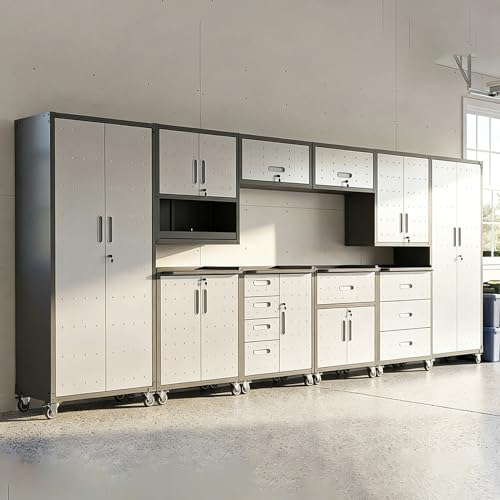
VIYET Heavy Duty Steel Garage Cabinet System — Heavy-duty steel cabinet system thinking for garages that need tougher enclosed storage and a more serious workshop aesthetic.
Open Shelving Still Belongs in Most Plans
Even cabinet-heavy garages should keep some open storage. Weekly bins behind doors slow you down and encourage floor piles “just for now.” Use cabinets for containment and wire for velocity. If everything is enclosed, inventory blindness returns—and so do duplicate purchases.
Label cabinet shelves on the inside edge. Photograph interiors once. Treat cabinet space with the same zoning discipline you use on open racks: auto, lawn, tools, household.
Kids, Pets, and Liability Thinking
Curiosity is not a character flaw—it is a planning input. Locks beat lectures. Store the ladder so it does not become a climbing toy to reach open high shelves. Keep the walking lane clear so night arrivals with groceries do not become trip events.
If your garage is also a play path to the backyard, prioritize lockable storage earlier than aesthetics. You can always add matching cabinet doors later; you cannot undo an exposure incident.
Design Details That Keep Either System Working
- Level cabinets on sloped slabs
- Secure tall units to studs
- Leave door-swing clearance for both car doors and cabinet doors
- Add lighting so dark cabinets do not become junk drawers
- Keep 10–20% empty capacity in both shelves and cabinets
Inventory Blindness: The Hidden Cost of Doors
Cabinets create calm by hiding contents—and that same hiding can recreate the chaos you were solving. If you cannot see it, you may buy it again. Fight inventory blindness with three habits: interior shelf labels, a contents list on the inside of each door, and a quarterly open-and-audit session that takes less time than a grocery run.
Photograph cabinet interiors after you organize them. When something is missing, you will know whether it was used up or merely migrated. For shared households, assign cabinet ownership lightly—“lawn,” “auto,” “paint”—so two people are not inventing competing systems inside the same doors.
Open shelving avoids blindness but creates visual fatigue. If open shelves stress you every time you enter from the kitchen, move the messiest categories behind doors first: chemicals, half-used project kits, and ugly bulk packaging. Keep the open wall for clean, matched totes only. That compromise often delivers both calm and speed.
Material Choices: Metal, Resin, and What to Avoid
Metal cabinets generally tolerate garage temperature swings better than budget particleboard furniture. Resin utility cabinets can be a practical mid step for household chemicals when budgets are tight—check latch quality and shelf adjustability. Avoid importing bedroom dressers into the garage; swollen bottoms and failed drawer glides are predictable.
Look for adjustable shelves, leveling feet, and a lock or padlock hasp if kids or pets are in the mix. Door alignment matters on uneven slabs; a cabinet that will not close becomes an open shelf with extra frustration. If you buy a multi-piece cabinet system, dry-fit the run and confirm the elevation before fully loading anything.
Door Swing Geometry in Tight Garages
Cabinet doors need clearance just like car doors. A beautiful tall cabinet placed too close to a parked mirror will either stay shut forever or collect collision scars. Measure door arc with painter’s tape. Consider sliding or biport styles only if the product category you buy truly supports them—do not assume.
Also plan for your body. You need standing room to open doors and retrieve a gallon jug without twisting into a fender. If the only place a cabinet “fits” is a slot you cannot stand in, it does not fit.
Hybrid Case Studies (Composite Suburban Patterns)
Family with young kids: lockable cabinet within a week, then open wire for toys-to-donate and sports totes, then overhead for holiday. Aesthetics wait. Safety does not.
Car enthusiast: closed cabinets for chemicals and polishes, open steel near the bench for project materials, floor kept clear for jack stands and turning radius. Visual calm is secondary to workflow and spill control.
Showroom-minded homeowner: matched cabinet elevation on the wall visible from the house, open shelving on the hidden side, overhead archive, and strict tote color standards. Budget is higher; satisfaction is high if parking remains easy.
Renter or short-horizon owner: freestanding lockable utility cabinet + freestanding wire racks that can move. Avoid heavy wall demolition for custom cabinets unless the landlord agreement and timeline support it.
Maintenance and Seasonal Reset
Twice a year, open every cabinet door and every tote lid on the open wall. Discard dried paint, mystery bottles, and expired chemicals per local rules. Wipe shelves. Re-level feet after winter slab movement. Confirm locks still work. A twenty-minute reset prevents a two-day excavation later.
When you add new products, assign them a home before they hit the floor. The floor is not a receiving department. If there is no home, either make one by purging or do not accept the item into the garage.
What to Put Where: A Practical Decision Matrix
Use this quick matrix when you are holding an item and stalling:
- Hazardous or tempting to kids/pets: lockable cabinet
- Weekly grab, sealed, labeled: open wire mid-height
- Seasonal, sealed, light-to-moderate: overhead rack
- Dust-sensitive tools: closed cabinet near the bench
- Ugly bulk packaging you refuse to look at: cabinet or opaque tote on wire
- Anything dripping, leaking, or unlabeled: do not store it—fix or dispose properly first
If an item fails every category, it may not deserve garage residency. The garage is not a museum of deferred decisions.
Finishing Touches That Make Hybrids Feel Intentional
Matched tote colors on open shelves, consistent label fonts, and aligned cabinet tops do more for perceived neatness than buying one more expensive unit. Add a simple cove of LED lighting above the cabinet run so dark interiors do not discourage use. Keep handles and locks at consistent heights when installing multi-piece systems so the wall reads as one elevation.
On the open side, line shelves with matching bins even if that means consolidating odd containers over a weekend. Visual rhythm is not merely aesthetic—it helps the brain reset items to the correct home. When everything looks unique, everything looks “fine wherever.”
Finally, connect the hybrid to the rest of the house: a small landing shelf or hooks near the house door prevents kitchen overflow from leaping straight onto the garage floor before it ever reaches a cabinet or tote.
Buying Checklist Before You Commit to Cabinets
Measure wall length, note outlets and hose bibs, confirm slab slope, and decide lock requirements before you shop. Check whether you need freestanding pieces that can move later or bolted modular runs. Compare interior shelf adjustability, not only exterior style. Read return policies, because a cabinet that does not level on your slab is not a bargain. Then re-check vehicle door swing with painter’s tape one more time—cabinet doors plus car doors create geometric problems that product photos never show.
FAQ: Cabinets vs Open Shelving
Are garage cabinets better than wire shelves?
They are better for hazards, dust control, and visual calm. Wire shelves are better for fast access to labeled bins. Most homes should combine them.
What should never go on open garage shelves?
Gasoline, strong solvents, pesticides, and other hazardous products—especially at child height. Use lockable cabinets and approved containers.
Do I need a full cabinet wall?
No. Start with one lockable cabinet and a wire run. Expand cabinets when safety and parking are already working.
Will metal cabinets rust in a garage?
Quality garage-oriented metal cabinets handle typical conditions better than cheap particleboard, but water intrusion and road salt still matter. Keep wet gear elsewhere and wipe spills.
How do I make cabinets as usable as open shelves?
Label interiors, zone by activity, add light, and avoid overstuffing. Doors only help if retrieval stays easy.
When you compare cabinet systems side by side, prioritize lock quality, shelf adjustability, and leveling hardware over minor style differences. A cabinet that closes squarely on a sloped slab will outperform a prettier unit that racks out of alignment within a season.
Next Steps
List what must be locked, what must be grabbed weekly, and what can live overhead. Buy the lockable cabinet first if hazards are currently on open shelves. Then build open wire for velocity and consider modular cabinets for the finished look.
Compare the reviewed cabinets above and continue through our Garage Storage hub. The winning garage is not “all open” or “all closed”—it is intentional about what each style protects.