
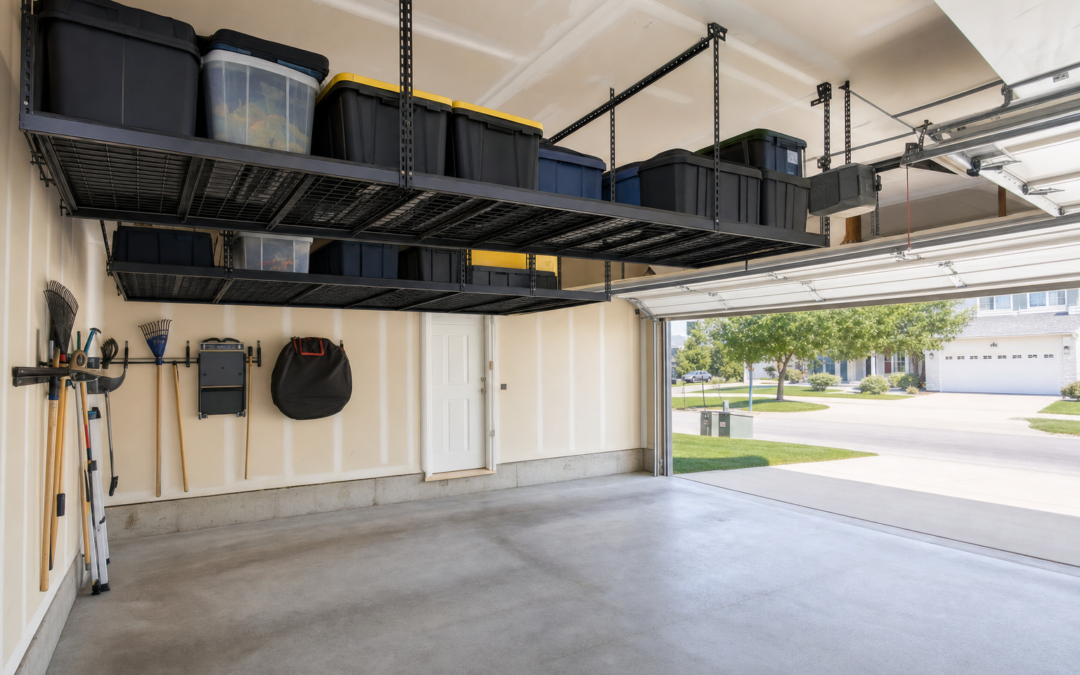
Ceiling space is the last free real estate in most suburban garages. While the floor fills with bins, bikes, and half-finished projects, the void between door tracks and joists stays empty—until a well-chosen overhead rack turns it into seasonal storage that does not steal a parking stall. This 2026 guide focuses on overhead and ceiling garage storage racks: how to size them, how to mount them safely, what load ratings actually mean, and which reviewed options fit common two-car layouts.
If you are still mapping the whole garage, start at our Garage Storage hub. For a broader systems overview, see our 2026 garage storage ideas pillar. Below we stay overhead: capacity, clearance, joists, and the products worth comparing before you drill.
Why Overhead Garage Storage Wins Floor Space
Every tote on the concrete is a negotiation with your car’s door swing. Overhead racks remove that negotiation for anything you open a few times a year—holiday décor, camping gear, luggage, bulk paper goods, and off-season sports equipment. The win is cubic feet without a permanent footprint in the vehicle envelope.
Overhead storage is not magic, though. A rack that hangs too low scrapes roof racks. A rack mounted into drywall alone is a failure waiting to happen. A rack loaded with paint cans above a windshield creates a drip-and-damage risk. Treat ceiling storage as engineered storage: measure twice, mount into framing, load sealed bins, and leave a buffer above your tallest parked profile.
- Best for: seasonal and archive items accessed a few times a year
- Poor fit for: weekly tools, leaking liquids, or anything kids need unsupervised
- Hard requirements: solid joists or approved framing, correct lag hardware, door-path clearance
Measure Before You Buy: Height, Door Travel, and Joists
Thirty minutes with a tape measure prevents the most expensive mistake in overhead storage—ordering a platform that cannot coexist with your garage door or truck.
Map the door and opener envelope
Open the garage door fully and mark the lowest point of tracks, springs, and opener rail. Close it and note torsion hardware near the header. Your rack must live outside that moving envelope. Side-bay racks along the long walls often clear door travel more easily than a rack centered over the door’s path.
Measure vehicle height with accessories
Include roof racks, cargo boxes, ladder racks, and antenna gear. Stand in the bay with the vehicle parked as you normally park—not “perfectly centered for the photo.” Leave several inches of buffer between the tallest roof point and the lowest rack surface. If you own a tall SUV or truck, confirm numbers before you fall in love with a deep 4×8 platform.
Find joists the honest way
Use a quality stud/joist finder, then verify with small exploratory holes or by spotting fastener patterns in unfinished ceilings. Many two-car garages have joists on 16-inch or 24-inch centers; rack kits expect you to hit them. If your ceiling is finished drywall with unknown framing, pause and investigate—do not guess with toggle bolts meant for pictures.
Plan tote sizes first
Buy bins that fit the platform grid, not the other way around. A 4×8 rack packed with mismatched cardboard boxes wastes capacity and looks chaotic from below. Matching sealed totes with labels on two sides make ladder trips purposeful instead of exploratory.
Load Ratings Without the Marketing Fog
A “750 lb capacity” label is only useful if you understand how that load is distributed. Ask three questions:
- Is the rating for the whole platform or per section? Some kits share load across multiple panels.
- What mounting pattern does the rating assume? Missing joists voids the number.
- Are you loading evenly? Piling all weight on one corner creates torque the marketing photo never shows.
Keep the heaviest sealed bins toward support points, not cantilevered edges. Never store open liquids overhead. Recheck fasteners after the first week of loading and again after seasonal temperature swings—garages expand and contract more than living rooms.
Mounting Safety: Non-Negotiables
Overhead racks fail from shortcuts, not from physics being unfair. Follow the manufacturer’s lag length and pilot-hole guidance. If the kit ships with hardware sized for specific joist engagement, do not substitute shorter screws because they were “what you had.”
- Mount into solid framing—not drywall alone
- Use a stable ladder or scaffold; never a rolling office chair
- Have a second person steady panels during lift
- Load gradually; watch for deflection or fastener pull
- Keep a clear ladder home nearby so retrieval does not become improvisation
If anything creaks, sags, or shifts, unload immediately. A rack that “almost” holds is not a storage system—it is a hazard above a vehicle you care about.
Layout Patterns That Work in Two-Car Garages
Side-bay seasonal wings
Place racks along the outer thirds of the ceiling so the center stays open for door travel and lighting. This pattern suits households that park two vehicles nightly and only need holiday and camping overflow overhead.
Deep platform for archive bulk
A large rectangular platform shines when you have a known dead zone—often above the hood area when cars are pulled forward, or along a side wall where door tracks do not swing. Confirm the lowest point with the door open and closed.
Modular frame kits
Frame-style kits let you expand in sections as your bin count grows. Start with one bay, prove the mounting and clearance, then add length rather than guessing a giant footprint on day one.
Product Callouts: Overhead Racks We Review
These four options cover common suburban needs—from large seasonal platforms to brand-focused ceiling systems. Open each review for dimensions, capacity notes, and who the rack fits best.
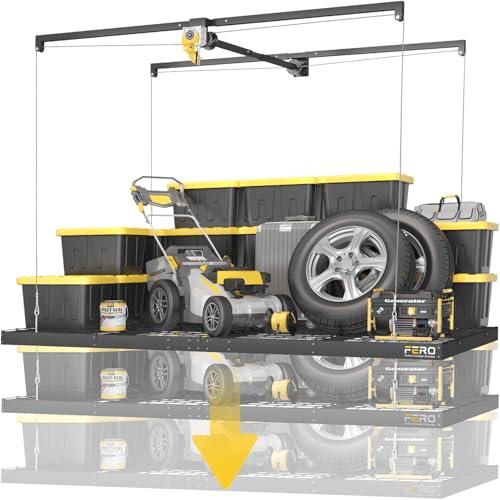
Garage Ceiling Storage Racks — A practical starting point when you want a dedicated ceiling platform for sealed seasonal totes without building a custom wood loft. Focus on joist layout and vehicle clearance before you commit to footprint.

MonsterRax Overhead Storage Rack Frame Kit — Choose a frame-kit approach when you want modular expansion and a structured mounting plan. Ideal if you prefer to grow overhead capacity in stages as bins multiply.
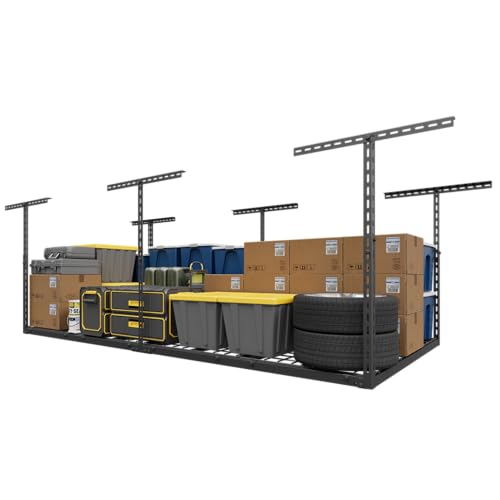
4X8FT Overhead Garage Storage Rack 750LBS Capacity — A large 4×8-class platform aimed at serious seasonal overflow—holiday décor, camping totes, and luggage—when your joists and door clearance can support the footprint and rated load.

FLEXIMOUNTS Overhead Garage Ceiling Storage Rack — A brand-focused ceiling rack option with clear mounting guidance for typical garages. Strong pick when you want adjustable height planning and a known hardware ecosystem.
What Belongs Overhead (and What Does Not)
Put sealed, labeled, relatively light-to-moderate bulk up high. Keep hazards and weekly tools elsewhere.
- Good overhead candidates: holiday lighting totes, camping gear, luggage, empty coolers, bulk paper goods, off-season clothing bins
- Keep off overhead racks: gasoline, solvents, pesticides, paint cans that can drip, loose metal scrap, anything unlabeled
- Better on wall shelves: weekly sports gear, household overflow you open often
- Better in locked cabinets: chemicals, sharp tools, anything child-accessible
Label every tote on two sides before it goes up. Inventing a filing system while balanced on a ladder is how boxes get permanently mysterious.
Installation Weekend Game Plan
- Friday night: measure door travel, vehicle height, and joist centers; sketch rack placement
- Saturday morning: stage hardware, confirm lag length, clear the bay of cars
- Saturday install: mount per instructions, level the platform, verify clearances with door cycles
- Saturday afternoon: load empty totes first to test fit; then add weight gradually
- Sunday check: re-torque accessible fasteners; photograph the layout for family reference
Budget time for an extra trip to the hardware store. Missing washers and wrong pilot bits are normal—rushing the lift is not.
Overhead Storage and the Rest of Your Garage System
Ceiling racks work best as the archive layer in a larger plan. Wire shelving handles weekly bins. Cabinets lock chemicals. A workbench keeps projects off the hood. If your floor is still buried after adding overhead storage, you needed wall systems too—not a bigger platform.
Sequence purchases this way for most two-car homes: clear walking lanes and vehicle envelope first, add wall shelving for frequent-access items, lock hazards in a cabinet, then install overhead racks for true seasonal overflow. That order prevents the common mistake of hanging a beautiful rack while the floor stays unusable.
Budget and Expectation Setting
Expect to spend on the rack, correct fasteners if the kit is incomplete for your framing, matching totes, and optionally better lighting so ladder work is safe. Labor is mostly careful measuring and a two-person lift. Custom wood lofts can look great but often cost more in time and reduce future flexibility; manufactured racks win when you want rated hardware and a known capacity story.
Cheap racks that skip serious mounting guidance are false economy. The vehicle underneath is worth more than the difference between a thoughtful kit and a mystery platform from a vague listing.
Common Mistakes With Ceiling Racks
- Mounting into drywall only
- Ignoring garage-door open height
- Storing liquids and chemicals overhead
- Overloading one corner of the platform
- Using a wobbly chair instead of a proper ladder
- Skipping labels so every retrieval becomes a scavenger hunt
- Blocking light fixtures or smoke/CO devices with the rack footprint
Joist Patterns, Lag Screws, and When to Call a Pro
Not every garage ceiling is a friendly grid of exposed 2x lumber. Some are drywalled. Some have trusses with thin bottom chords that were never meant for concentrated point loads. Some have radiant barriers, spray foam, or awkward HVAC runs that steal mounting real estate. Before you order a rack because the photo looks perfect over someone else’s clean joists, diagnose your own structure.
If joists are exposed, measure on-center spacing across the full proposed footprint—not just one bay. Racks that expect 16-inch centers can become a puzzle on 24-inch centers unless the manufacturer provides alternate brackets or a wood ledger plan. If the ceiling is finished, locate framing carefully and accept that you may need short exploratory openings that you later patch. Guessing is how lag screws find only gypsum.
Lag screw length and diameter matter more than brand loyalty. The screw must engage solid wood deeply enough for the rated load after accounting for drywall thickness. If your kit assumes bare joists and you have half-inch drywall plus a gap, the included lags may be too short. Upgrade hardware rather than pretending the rating still applies. Washers distribute load; skip them only if the instructions explicitly use a different head bearing design.
Call a professional when any of these are true: you cannot verify framing, you have engineered trusses and the manufacturer is silent about them, you are mounting over a parking spot with no tolerance for failure, or you simply are not comfortable working overhead with a helper. The cost of a clean install is usually less than one insurance deductible or one ruined roof of a vehicle.
Seasonal Loading Calendar for Overhead Bins
Overhead storage works best when it follows a calendar instead of becoming a graveyard. Create a simple seasonal rotation so ladder trips are batch jobs, not weekly inconveniences.
- January–February: holiday décor stays up; camping and summer sports stay down on wall shelves
- March–April: swap holiday totes up (or to donate), bring spring sports and gardening overflow to mid shelves
- May–August: camping and travel luggage may cycle between overhead and a staging shelf depending on trip frequency
- September–October: reverse summer bulk upward; prepare holiday zone labels before peak season
- November–December: holiday totes come down early enough that you are not climbing in the dark on December 23
Write the season on the tote end in large characters. “Holiday / lights / fragile” beats “Box 7.” If multiple adults share the garage, a printed legend taped inside a cabinet door prevents creative reinterpretations of your system.
Lighting, Ladders, and Human Factors
A perfect rack in a dark bay still produces bad decisions. Add bright LED shop lights that illuminate the underside of the platform and the ladder footprint. Motion lighting near the man door helps when you arrive with arms full and need to see obstacles.
Choose a stepladder tall enough to reach the rack without standing on the top cap. Store that ladder on a wall hook dedicated to it—not leaning on the rack it serves. If someone in the household cannot climb safely, overhead storage for their items is the wrong layer; keep their seasonal goods on mid-height shelves instead.
Two-person loads are safer than hero lifts. Slide sealed totes rather than freestyle pressing them overhead when possible. If a tote is heavy enough to surprise you at shoulder height, it is too heavy for the top of a ladder session—split the contents.
Comparing Platform Footprints Without Marketing Hype
Large rectangular platforms maximize tote count per install session. Modular frames maximize flexibility. Brand ecosystems maximize confidence in hardware availability. None of those virtues matter if the lowest point of the rack intersects your door opener travel or your cargo box.
Make a cardboard mockup of the rack outline and tape it to the ceiling area (or hold it with a helper) while you cycle the door. It looks silly. It is cheaper than returns. Confirm that light fixtures, sensors, and sprinkler heads—if present—remain unobstructed and serviceable.
Also plan the “drop zone.” When a tote comes down, where does it land? A clear rectangle of floor near the ladder beats balancing a bin on a car hood. That drop zone can be temporary, but it must exist in your mental map.
FAQ: Overhead Garage Storage Racks
How much weight can overhead garage racks hold?
Consumer ceiling racks commonly advertise a few hundred pounds up through roughly 750 lb or more for larger platforms—but only when mounted as specified into adequate framing and loaded evenly. Always treat the published number as a ceiling, not a target, and read our product reviews for model-specific notes.
Will a ceiling rack work with a garage door opener?
Yes, if you keep the rack outside the door’s travel path and clear of the opener rail, sensors, and springs. Measure with the door fully open. When in doubt, place racks toward side bays rather than directly under the opener’s run.
Can I install an overhead rack myself?
Many homeowners can, with a helper, a proper ladder, a stud/joist finder, and willingness to follow lag-screw instructions. If you cannot verify framing or you are uncomfortable working overhead, hire a pro. The risk of a failed mount is not worth DIY pride.
What size overhead rack do I need?
Size to your sealed tote plan and clear ceiling rectangle—not to the largest product photo. A smaller rack that stays fully loaded with labeled bins beats a giant empty frame that crowds the door.
Are overhead racks safe above cars?
They can be, when mounted correctly, loaded with sealed non-hazardous goods, and kept within rated capacity. They are unsafe as drywall-only installs or as storage for liquids and chemicals. Inspect fasteners periodically.
Next Steps
Measure joists, door travel, and vehicle height this week. Decide what truly belongs overhead versus on wall shelves. Then compare the reviewed racks above and open the full notes on capacity and dimensions before you buy.
Browse more garage systems in our Garage Storage hub, and keep the floor clear by treating the ceiling as archive space—not a dumping ground. A cleaner garage starts with honest clearance math and hardware that hits real wood.