
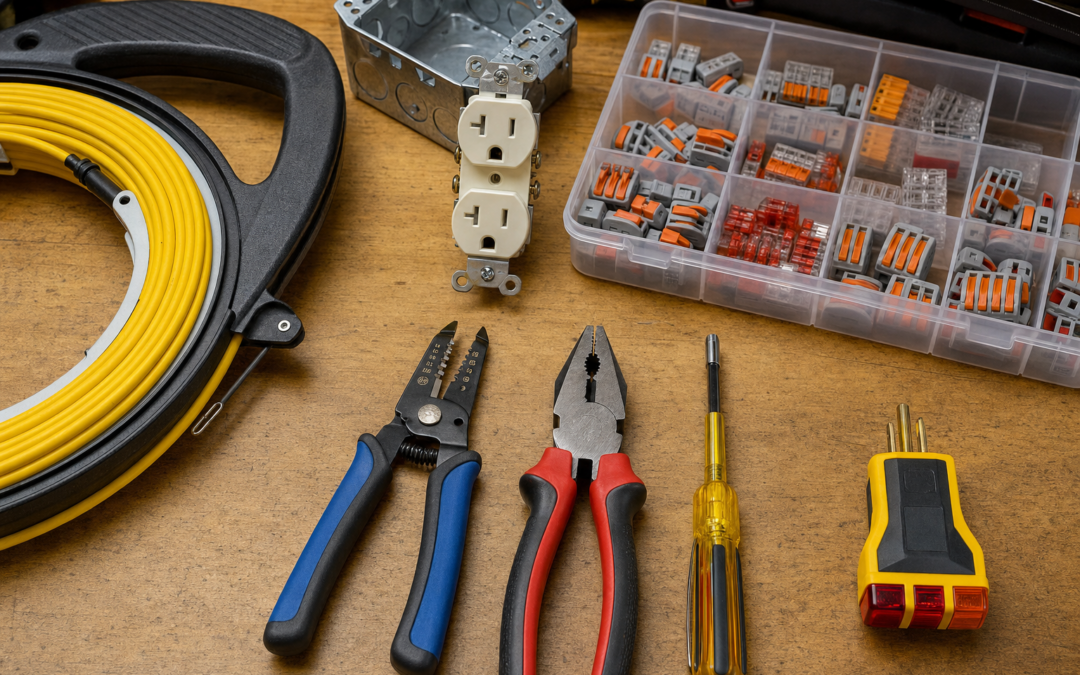
Electrical DIY goes wrong fastest when people skip testing tools and grab the wrong cutters. A small, deliberate kit—voltage testers, strippers, connectors, fish tape, and solid pliers—covers most homeowner jobs: devices, lighting, and fishing cable through unfinished spaces. This guide builds that kit and draws a bright line where professionals should take over.
More how-tos live in our Electrical hub. Safety first: prove circuits dead, respect panels, and hire a licensed electrician for unfamiliar work or anything inside the service panel.
Tester First, Tools Second
Before any screwdriver turns, you need a way to verify power is off. A non-contact voltage tester is the quick sniff test; a plug-in outlet tester checks polarity and grounding on receptacles; a kit that includes GFCI testing earns its keep in kitchens and baths. None of these replace judgment, but they catch the “wrong breaker” mistake.
Learn what your tester cannot do. Non-contact tools can false-trigger near paired conductors. When readings confuse you, stop and reassess rather than assuming “dead enough.”

Klein Tools 80025 Outlet Tester Kit with GFCI Tester and Non-Contact — An outlet tester kit with GFCI testing and a non-contact pen covers the verification triangle: receptacle wiring status, GFCI trip check, and a quick scan for live conductors before you touch a device yoke.

Klein Tools RT110 Outlet Tester — A simple three-light outlet tester remains the fastest way to spot reverse polarity or open grounds on standard receptacles. Pair it with a non-contact tester—do not rely on one instrument alone.
Strippers and Connectors That Match Wire Gauge
Use a stripper indexed for the gauges you actually cut—commonly 12 and 14 AWG on residential branch circuits, plus low-voltage sizes for thermostats and some lighting. Avoid knives that nick copper; nicked conductors break inside wire nuts months later.
Lever connectors and quality twist-on connectors beat electrical tape footballs. Match the connector listing to solid/stranded and to the number of conductors. In boxes crammed with smart devices, lever connectors can reduce bulk and make future troubleshooting kinder.

Gardner Bender GS-360 Electrical Wire Stripper & Lock Tool — A dedicated electrical stripper with clearly marked gauge holes is safer and cleaner than improvised cutting. Strip only as much insulation as the device terminal requires—no bare copper fireworks waiting to short on the box.

Ideal Electrical 30-1010 InSure 10 AWG Lever Connector Kit ( of Lever Wire — A lever connector kit sized for common branch-circuit gauges speeds pigtails for smart switches and GFCI devices. Use listed connectors only, and keep a few spares in the kit so you never reuse scorched nuts.
Pliers, Fish Tape, and the Rest of the Belt
Lineman’s pliers twist, cut, and grip; needle-nose reach into boxes; diagonal cutters trim flush. A fish tape pulls cable through conduit or open walls—steel tapes are common for conduit, while non-conductive tapes have niches near existing conductors. Do not force fish tapes into unknown paths that might snag live cables; when walls are finished and paths are mysterious, professionals with toners and experience save patchwork.

Southwire 58279840 1/8 in. 240 ft. Steel Fish Tape — A long steel fish tape earns its place when you have conduit or clear pathways to pull new cable. Wear eye protection, push slowly, and never assume a cavity is empty of live wiring.

Klein Tools D213-8NE Lineman’s Pliers, 8-Inch, Silver — Solid lineman’s pliers remain a daily driver for twisting wires, gripping locknuts, and cutting conductors to length. Pair them with insulated habits: power off, verify dead, then work.
Consumables and Box Hygiene
Stock: wire nuts/levers in common sizes, short pigtails, electrical tape for identification (not as the primary splice), cable staples of the correct type, and a headlamp. A torque screwdriver helps hit device terminal specs. Labels and a permanent marker turn a chaotic panel into a map.
Vacuum metal bits from boxes before restoring power. Fold wires so devices seat without springing out. Overstuffed boxes need extensions—not hammers.
Jobs This Kit Is For—and Not For
Good DIY candidates: replacing like-for-like receptacles and switches on known dead circuits, swapping light fixtures with adequate support, installing listed smart devices when wiring matches, testing GFCIs.
Hire it out: panel upgrades, new circuit home runs you cannot fish safely, aluminum branch remediation, meter-side work, anything that requires pulling the service cover, and any job where you cannot prove what each conductor does.
Habits That Keep Electrical Upgrades Reliable
Once a quarter, test GFCI and AFCI devices with their built-in buttons and confirm protected outlets still trip correctly. Replace any device that will not reset or that trips with no load—do not tape over a problem. Retire cracked tester cases, weak batteries in non-contact pens, and scorched connectors. A dead tester is worse than no tester because it breeds false confidence.
Label breakers as you learn them. Photograph the panel directory after changes. Keep spare outlet testers, wire nuts, and a headlamp in a small kit so future work is safer and faster. Dust and heat shorten device life; leave ventilation space around dimmers and smart switches that run warm.
Seasonal storms are a good reminder to unplug sensitive electronics and confirm outdoor covers and weatherproof in-use lids still seal. A five-minute walk-through beats replacing water-damaged receptacles later.
Safety, Codes, and Know-Your-Limits
Turn off the correct breaker and verify the circuit is dead with a non-contact tester and an outlet tester before you touch wires. Lock the panel door or leave a note so nobody restores power while you work. If anything about the panel, bus bars, or main breaker feels unfamiliar, hire a licensed electrician—panel work is not a casual DIY project.
Match device ratings to the circuit (amps and voltage). Use the wire nuts or lever connectors specified for your conductor size. Do not force oversized devices into shallow boxes; pigtail and use a deeper box when needed. Local codes and permits matter for new circuits, kitchen/bath rewires, and outdoor work.
Stop and call a pro if you find aluminum branch wiring you were not expecting, burned insulation, melted devices, shared neutrals you cannot map, or a panel with no clear labeling. Guessing around live parts is how shocks and house fires start.
Buying Checklist
- Non-contact tester + receptacle/GFCI tester
- Gauge-accurate stripper
- Lever or nut connectors for 12/14 AWG
- Lineman’s and needle-nose pliers
- Fish tape only if you have real pull paths
- PPE: eye protection, gloves as needed
FAQ: Basic Electrical Tools
Is a multimeter required?
Helpful, not first. Many homeowners begin with non-contact and plug-in testers; add a meter when you learn to use it safely.
Can I work in the panel with good pliers?
Having tools does not make panel work appropriate. Service equipment is a licensed electrician zone for most homeowners.
Cheap tester vs pro brand?
Buy from reputable makers and replace tools that act erratically. Your body is not the place to save twenty dollars.
How do I store the kit?
Dry tote, spare batteries, printed breaker map. Keep it out of kids’ reach.
Next Steps
Assemble the kit before the next outlet fails at night. Compare the tools above, practice testing on a known live receptacle, then kill a breaker and confirm your workflow. Continue learning through our Electrical hub. Confidence should come from verification—not from hope.
When a project outgrows the kit, pause. Calling an electrician early is cheaper than drywall repairs, insurance claims, or worse. The best DIY electrical work looks boring: neat wires, correct devices, labeled breakers, and testers that agree.
Photograph every open box before you close it. Future you—or a future electrician—will thank present you for the breadcrumbs.
Practical Notes for Basic Electrical Tools Every DIY Homeowner Should Own
Keep receipts, warranty info, and a phone photo of model numbers in a home maintenance album. When a device fails years later, identity beats guesswork. Schedule a seasonal reminder to retest GFCIs, confirm breaker labels, and check that outdoor covers still seal after storms.
If you share the home with guests or renters, label the panel clearly and leave a one-page tip sheet in a kitchen drawer: how to shut off power, which receptacles are GFCI-protected, and when to call an electrician instead of resetting forever. Clear instructions prevent panicked mistakes.
Choose listed devices and fresh connectors over mystery bin parts. Compatibility mistakes and reused scorched wire nuts cost more time than the dollars you save.
Practical Notes for Basic Electrical Tools Every DIY Homeowner Should Own
Keep receipts, warranty info, and a phone photo of model numbers in a home maintenance album. When a device fails years later, identity beats guesswork. Schedule a seasonal reminder to retest GFCIs, confirm breaker labels, and check that outdoor covers still seal after storms.
If you share the home with guests or renters, label the panel clearly and leave a one-page tip sheet in a kitchen drawer: how to shut off power, which receptacles are GFCI-protected, and when to call an electrician instead of resetting forever. Clear instructions prevent panicked mistakes.
Choose listed devices and fresh connectors over mystery bin parts. Compatibility mistakes and reused scorched wire nuts cost more time than the dollars you save.
Practical Notes for Basic Electrical Tools Every DIY Homeowner Should Own
Keep receipts, warranty info, and a phone photo of model numbers in a home maintenance album. When a device fails years later, identity beats guesswork. Schedule a seasonal reminder to retest GFCIs, confirm breaker labels, and check that outdoor covers still seal after storms.
If you share the home with guests or renters, label the panel clearly and leave a one-page tip sheet in a kitchen drawer: how to shut off power, which receptacles are GFCI-protected, and when to call an electrician instead of resetting forever. Clear instructions prevent panicked mistakes.
Choose listed devices and fresh connectors over mystery bin parts. Compatibility mistakes and reused scorched wire nuts cost more time than the dollars you save.
Practical Notes for Basic Electrical Tools Every DIY Homeowner Should Own
Keep receipts, warranty info, and a phone photo of model numbers in a home maintenance album. When a device fails years later, identity beats guesswork. Schedule a seasonal reminder to retest GFCIs, confirm breaker labels, and check that outdoor covers still seal after storms.
If you share the home with guests or renters, label the panel clearly and leave a one-page tip sheet in a kitchen drawer: how to shut off power, which receptacles are GFCI-protected, and when to call an electrician instead of resetting forever. Clear instructions prevent panicked mistakes.
Choose listed devices and fresh connectors over mystery bin parts. Compatibility mistakes and reused scorched wire nuts cost more time than the dollars you save.
Practical Notes for Basic Electrical Tools Every DIY Homeowner Should Own
Keep receipts, warranty info, and a phone photo of model numbers in a home maintenance album. When a device fails years later, identity beats guesswork. Schedule a seasonal reminder to retest GFCIs, confirm breaker labels, and check that outdoor covers still seal after storms.
If you share the home with guests or renters, label the panel clearly and leave a one-page tip sheet in a kitchen drawer: how to shut off power, which receptacles are GFCI-protected, and when to call an electrician instead of resetting forever. Clear instructions prevent panicked mistakes.
Choose listed devices and fresh connectors over mystery bin parts. Compatibility mistakes and reused scorched wire nuts cost more time than the dollars you save.
Practical Notes for Basic Electrical Tools Every DIY Homeowner Should Own
Keep receipts, warranty info, and a phone photo of model numbers in a home maintenance album. When a device fails years later, identity beats guesswork. Schedule a seasonal reminder to retest GFCIs, confirm breaker labels, and check that outdoor covers still seal after storms.
If you share the home with guests or renters, label the panel clearly and leave a one-page tip sheet in a kitchen drawer: how to shut off power, which receptacles are GFCI-protected, and when to call an electrician instead of resetting forever. Clear instructions prevent panicked mistakes.
Choose listed devices and fresh connectors over mystery bin parts. Compatibility mistakes and reused scorched wire nuts cost more time than the dollars you save.
Practical Notes for Basic Electrical Tools Every DIY Homeowner Should Own
Keep receipts, warranty info, and a phone photo of model numbers in a home maintenance album. When a device fails years later, identity beats guesswork. Schedule a seasonal reminder to retest GFCIs, confirm breaker labels, and check that outdoor covers still seal after storms.
If you share the home with guests or renters, label the panel clearly and leave a one-page tip sheet in a kitchen drawer: how to shut off power, which receptacles are GFCI-protected, and when to call an electrician instead of resetting forever. Clear instructions prevent panicked mistakes.
Choose listed devices and fresh connectors over mystery bin parts. Compatibility mistakes and reused scorched wire nuts cost more time than the dollars you save.
Practical Notes for Basic Electrical Tools Every DIY Homeowner Should Own
Keep receipts, warranty info, and a phone photo of model numbers in a home maintenance album. When a device fails years later, identity beats guesswork. Schedule a seasonal reminder to retest GFCIs, confirm breaker labels, and check that outdoor covers still seal after storms.
If you share the home with guests or renters, label the panel clearly and leave a one-page tip sheet in a kitchen drawer: how to shut off power, which receptacles are GFCI-protected, and when to call an electrician instead of resetting forever. Clear instructions prevent panicked mistakes.
Choose listed devices and fresh connectors over mystery bin parts. Compatibility mistakes and reused scorched wire nuts cost more time than the dollars you save.
Practical Notes for Basic Electrical Tools Every DIY Homeowner Should Own
Keep receipts, warranty info, and a phone photo of model numbers in a home maintenance album. When a device fails years later, identity beats guesswork. Schedule a seasonal reminder to retest GFCIs, confirm breaker labels, and check that outdoor covers still seal after storms.
If you share the home with guests or renters, label the panel clearly and leave a one-page tip sheet in a kitchen drawer: how to shut off power, which receptacles are GFCI-protected, and when to call an electrician instead of resetting forever. Clear instructions prevent panicked mistakes.
Choose listed devices and fresh connectors over mystery bin parts. Compatibility mistakes and reused scorched wire nuts cost more time than the dollars you save.